Issue 37: Right-wing Justices Behaving Badly
Plus: The Michigan Court of Appeals bars de facto life terms for youth

What You’ll Read:
Right-wing Justices Behaving Badly: Wisconsin and North Carolina Justices make news for all the wrong reasons
Michigan Court of Appeals: 40-year prison sentence for youth is “effectively a life sentence” that violates state constitution
The Growing Urgency of State Constitutional Antipunishment Rights
Cases To Watch: One of criminal law’s most shocking injustices goes back before the Michigan Supreme Court
Right-wing Justices Behaving Badly
North Carolina and Wisconsin have the most bitterly divided state supreme courts in the country, with Republicans recently re-taking the majority in North Carolina (while trying and failing to steal an additional seat) and liberals holding a new 4-3 majority in Wisconsin. And recently far-right justices on each court have received a spate of bad press, making headlines for their hyper-partisanship, trolling Twitter posts, and even fictitious case citations.
In Wisconsin, the court last month appointed a pair of three-judge panels to decide if the state’s extreme Republican gerrymander violates the state constitution—the first step toward striking the maps down. The court’s conservatives, of course, dissented, an almost foregone conclusion that would hardly be noteworthy except for one glaring error: Justice Annette Ziegler used a fake U.S. Supreme Court quote to support her dissent—and then effectively doubled down when called out, removing the quotation marks but leaving a false legal proposition that is the polar opposite of what the Court actually said.
Mark Joseph Stern explains in Slate:
Justice [] Ziegler … suggested that the imposition of a more balanced map would violate the U.S. Constitution. To make that point, Ziegler quoted a recent Supreme Court decision, Moore v. Harper, for the proposition that state courts’ role in congressional redistricting is “exceedingly limited.” There is just one problem: Moore said no such thing. That quotation appears nowhere in the ruling. To the contrary, Moore held the opposite, concluding that state courts can play a legitimate, meaningful role in congressional redistricting.
[...]
In the absence of a public explanation for this slip-up, we are left to speculate how, exactly, a state Supreme Court justice wound up misquoting SCOTUS in a major opinion. Was it a clerk’s error? An A.I. hallucination? Whatever the cause, it is not some trifling oversight; this blunder undermined Ziegler’s most important legal rejoinder to the majority. And her would-be correction preserves the original misrepresentation of what SCOTUS actually ruled.
Meanwhile, in North Carolina, ProPublica published a deep-dive feature that shows how Chief Justice Paul Newby and his conservative allies have shattered judicial norms to green light partisan gerrymandering and effectively give Republicans control of Congress:
As chief justice, he and courts under him have consistently backed initiatives by Republican lawmakers to strip power away from North Carolina’s governor, thwarting the will of voters who have chosen Democrats to lead the state since 2016. He’s also used his extensive executive authority to transform the court system according to his political views, such as by doing away with diversity initiatives. Under his leadership, some liberal and LGBTQ+ employees have been replaced with conservatives. A devout Christian and church leader, he speaks openly about how his faith has shaped his jurisprudence and administration of the courts.
According to former justices, judges and Republicans seeking to be judicial candidates, Newby acts more like a political operator than an independent jurist. He’s packed higher and lower courts with former clerks and mentees whom he’s cultivated at his Bible study, prayer breakfasts and similar events. His political muscle is backed by his family’s: His wife is a major GOP donor, and one of his daughters, who is head of finance for the state Republican Party, has managed judicial campaigns.
[...]
Gene Nichol, a professor of constitutional law at the University of North Carolina at Chapel Hill, said Newby had essentially turned the court into an arm of the Republican Party. “Newby,” he said, “has become the chief justice who destroyed the North Carolina Supreme Court as an impartial institution.”
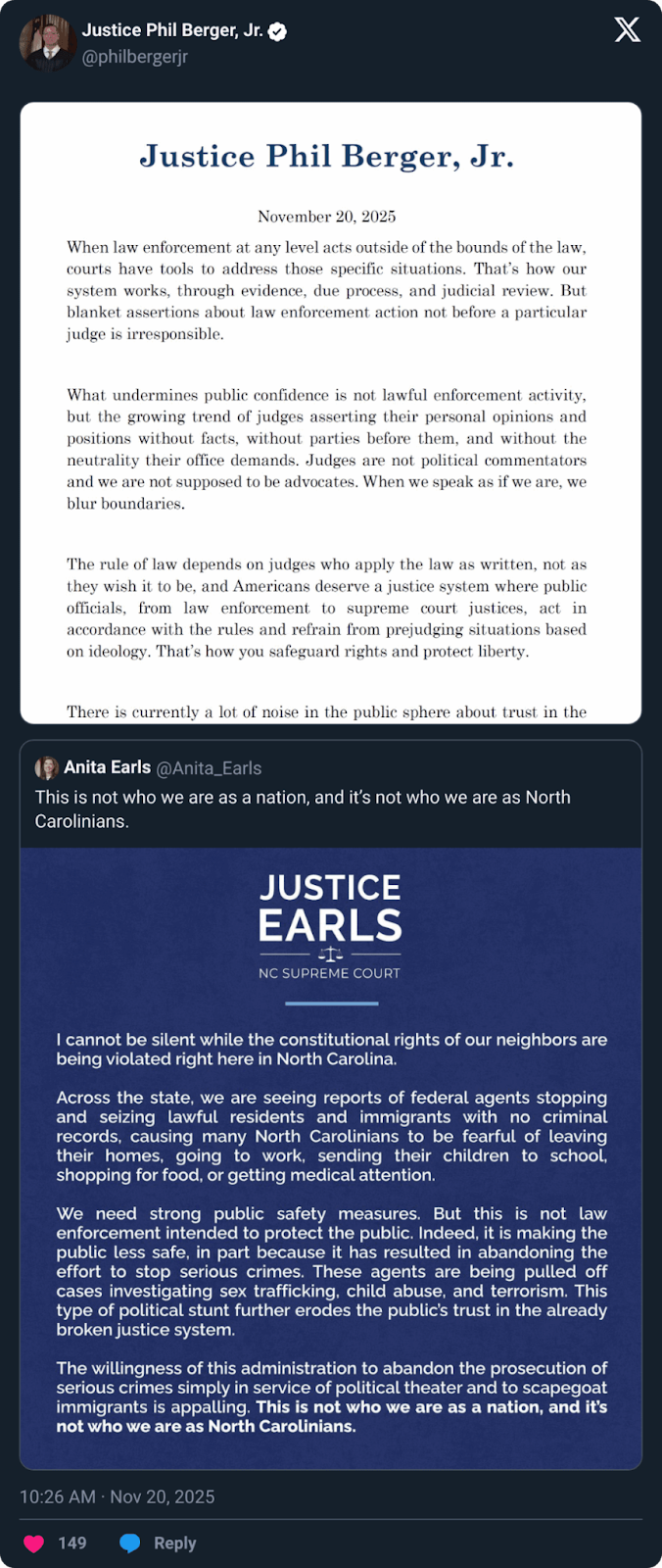
Yet fellow-Republican Phil Berger Jr. took to X/Twitter to publicly condemn not Newby, but liberal Justice Anita Earls. Her offense? Speaking plainly about unlawful and inhumane immigration enforcement tactics in North Carolina. “I cannot be silent while the constitutional rights of our neighbors are being violated,” Earls wrote. This was too much for Berger, who said, without irony, that Earls’s statement risks “undermining public confidence” in the courts and that the “rule of law depends on judges who apply the law as written, not as they wish it to be.”
Michigan Court of Appeals: 40-year prison sentence for youth is “effectively … a life sentence” that violates state constitution
In 2022, the Michigan Supreme Court issued a series of rulings that protect young people from extreme prison terms. Among them was People v. Stovall, which held that even life with the possibility of parole violates Michigan’s “cruel or unusual” punishment clause when given to youth convicted of second degree murder. Last week, the Michigan Court of Appeals—the state’s intermediate appellate court—extended that protection to 40-year prison terms, reasoning that sentences of such length are “effectively … a life sentence,” and therefore violate the state constitution for people under age 18 in second-degree murder cases.
[Full Opinion in People v. Hubbert | Law360]
The Growing Urgency of State Constitutional Antipunishment Rights
The need for state constitutional rulings like Hubbert is even greater as the U.S. Supreme Court turns increasingly hostile to civil rights. As it stands, SCOTUS is already the “Court of Mass Incarceration” for its refusal to limit the most extreme and disproportionate criminal punishments. As I’ve argued many times, the Court’s abject failure to enforce constitutional rights against “cruel and unusual” punishments is reason alone for state supreme courts, relying on state constitutions, to forge their own jurisprudential path.
But things could soon get even worse. In Hamm v. Smith, which will be argued on Wednesday, the Court could revisit its seminal 2002 ruling Atkins v. Virginia that banned executing people with intellectual disability. Given its current composition, the Court is likely to at least narrow Atkins and give states more leeway to kill those whom Atkins once protected. But as Ian Millhiser points out in Vox, a broader, even more radical holding could entirely wipe out what little federal protections people have from the most severe criminal sanctions.
In recent opinions, Justice Neil Gorsuch and the Court’s other Republican members have seemed to embrace a disturbing theory once championed by the late-Justice Antonin Scalia: That the 8th Amendment prohibits only certain types of punishment—specifically, medieval torture methods such as “disemboweling” or “burning alive” that were disfavored at the Founding—and does not prohibit excessive or disproportionate sentences at all.
“If the Court embraces this approach,” Millhiser writes, “it would likely mean the end of most modern-day restrictions on cruel or excessive punishments.” For example, “Scalia argued that the Eighth Amendment only forbids always-and-everywhere ‘cruel’ punishments … and does not prevent the government from imposing excessive punishments for minor crimes. If the Constitution permits the state to execute murderers, then it may also impose the death penalty for lesser offenses such as shoplifting or driving over the speed limit.”
And if that radical view takes hold in federal law, state constitutional rights would be necessary not just to expand rights, but to preserve the limited status quo of rights protections we have today.
Cases To Watch: One of criminal law’s most shocking injustices goes back before the Michigan Supreme Court
The Michigan Supreme Court on Wednesday will (again) hear argument in People v. Langston, which asks whether life without parole sentences for people convicted of “felony murder” are unconstitutional “cruel or unusual” punishment. At issue are people convicted of murder without a jury finding that they either killed or intended to kill anyone, and who were convicted before the Michigan Supreme Court in 1980 added a “malice” requirement to the state’s felony murder law.
In one sense, the stakes in Langston are relatively small: a favorable ruling would apply only to people convicted over 45 years ago. But even setting aside what it would mean for those people to have a chance at freedom, how the court rules could influence how other state courts treat excessive punishment claims in felony murder cases and in other challenges that do not turn on the age of the offender—including, for example, challenges to three-strikes “habitual” or “repeat offender” sentence enhancements. It is a case, in other words, that could open the door to a wider variety of constitutional claims against the most draconian sentencing practices.
Ahead of argument, SLRI and the MacArthur Justice Center filed a supplemental amicus brief reiterating our position that all mandatory LWOP sentences violate Michigan’s constitution. [Read the SLRI Amicus Brief]